Office and education
Daylight harvesting, occupancy sensing and scene changes require stable low-level dimming without visible steps. Ceiling void temperature, plenum access and emergency integration influence the driver choice.
Application matrix
The load window is only the first filter. Enclosure temperature, operating hours, dimming depth, emergency behavior, sensor topology and service access change with the installation.
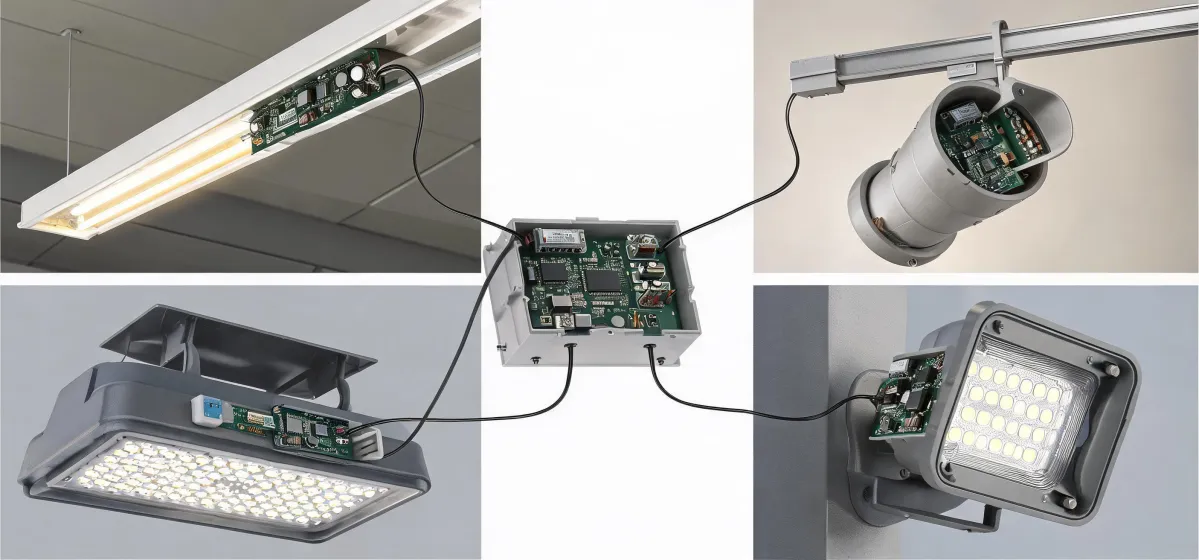
Daylight harvesting, occupancy sensing and scene changes require stable low-level dimming without visible steps. Ceiling void temperature, plenum access and emergency integration influence the driver choice.
Deep dimming, warm-dim behavior, track integration and repeated switching place emphasis on control compatibility, acoustic performance and consistent current regulation.
Clinical tasks, night modes and emergency circuits need defined fade behavior, low-output stability, service labeling and clear separation of normal and essential supplies.
Long operating hours, high ambient temperature, surge exposure and difficult access make thermal headroom, protection strategy and replaceability central to lifecycle planning.
Ingress, temperature cycling, remote dimming and surge environment must be addressed at luminaire and site level. A driver IP rating cannot compensate for an unsuitable enclosure.
DALI-2 addressing, sensor coverage, gateways and supervisory platforms require an agreed topology, commissioning record, firmware expectation and fault-recovery plan.
Two drivers with the same power label may have different current ranges, voltage ceilings, thermal derating and overload behavior. Plot the intended LED voltage across tolerance and temperature. Confirm that the programmed current and worst-case load remain within the published window, then validate the combination in the actual luminaire.
Central supervision can simplify schedules and reporting; distributed sensing can improve local responsiveness and fault isolation. The correct choice depends on zoning, cable routes, gateway dependence, commissioning skills and the maintenance model. Interface labels alone do not define a workable sequence.
Describe the luminaire, operating environment and control sequence before comparing model suffixes.